AI, Bots and Cybersecurity: Why Businesses Need Stronger Online Protection
When an online store suddenly slows down, hits server resource limits or shows unexplained traffic spikes with no matching orders, real visitors are often not the cause. A large share of that load comes from automated scripts (bots) scanning sites around the clock for vulnerabilities, scraping prices or testing stolen passwords.
Over the past year, AI tools have made these operations much faster, cheaper and easier to run at scale. Below, we look at what recent traffic data shows, how malicious bots differ from AI crawlers, and how a Web Application Firewall (WAF) filters unwanted requests before they strain your website or store.
More bot traffic than human visitors
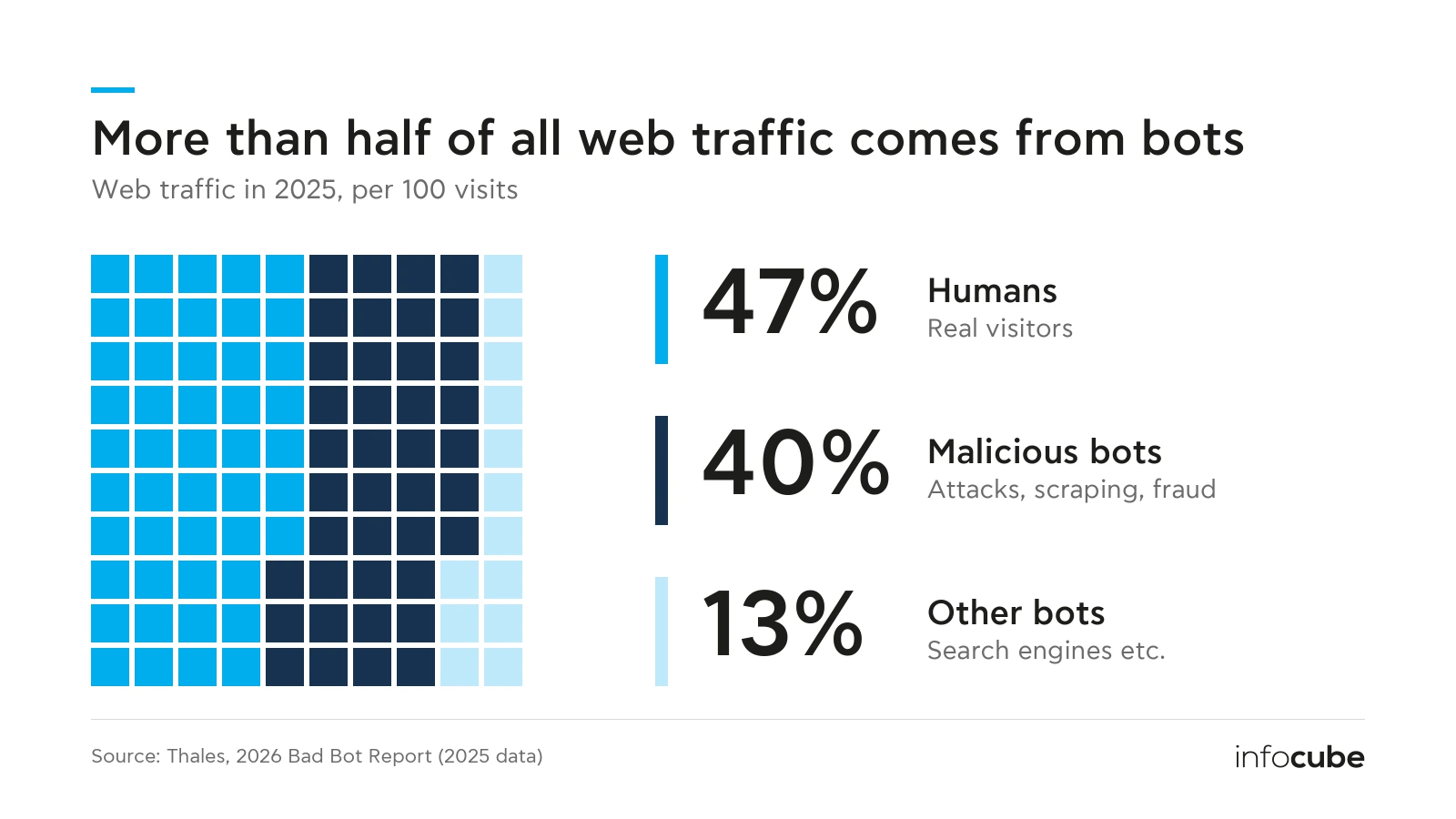
According to the Thales 2026 Bad Bot Report, based on real web traffic recorded during 2025, automated requests now outnumber human visits online:
- More than 53% of total web traffic came from bots and automated systems, compared with 47% from human visitors.
- Malicious bots accounted for 40% of all recorded traffic.
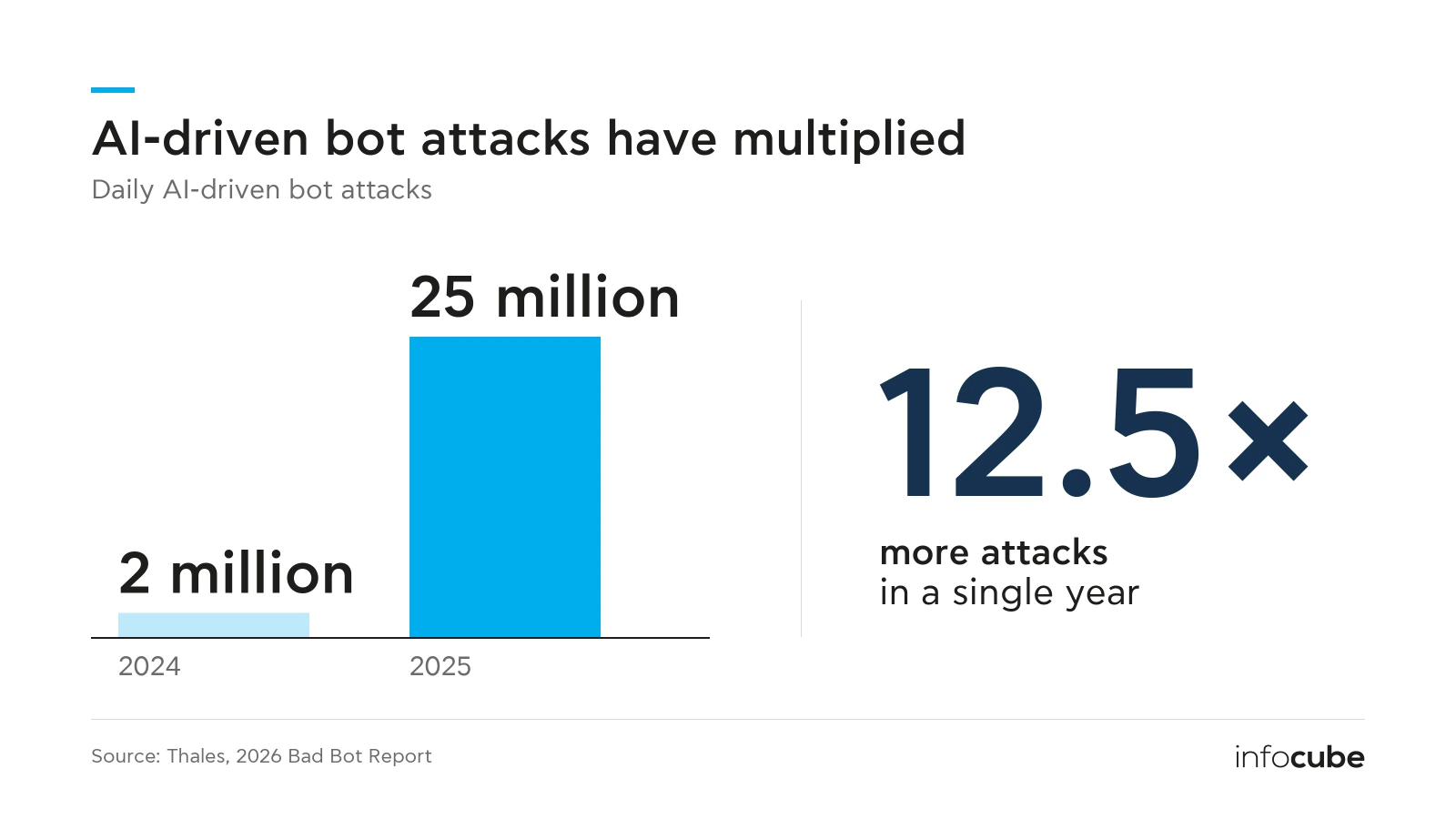
- Daily AI-driven bot attacks jumped from 2 million in 2024 to 25 million in 2025, a 12.5-fold increase in a single year.
We see the same pattern at Infocube in the statistics from monitoring our own systems, where bot traffic and automated requests run at similar levels. In practical terms, many businesses spend more than half of their bandwidth, memory and server CPU serving automated scripts rather than prospective customers.
Why AI is changing the scale of automated attacks
Automated vulnerability scanning is nothing new, but AI has lowered the barrier to running and adapting it. Modern tools can probe thousands of domains at once for outdated plugins, exposed admin endpoints or weak login forms, while adjusting their behaviour to mimic ordinary browsers.
A small or mid-sized business no longer needs to be specifically targeted to face an attack. Simply having a website or online store accessible on the public web means automated scans run against it continuously, regardless of company size, brand visibility or industry.
AI crawlers: non-malicious traffic that still strains your site
Not every bot has malicious intent. Alongside attack scripts, search engines and AI platforms send out crawlers to index content and answer user questions. According to the Cloudflare Radar 2025 annual report, traffic from AI crawlers visiting sites to answer user queries grew more than fifteenfold during 2025.
Even when that activity is not trying to breach anything, high request volumes can still hurt site performance. On an online store with thousands of products, variants and search filters, aggressive crawlers can trigger thousands of requests in minutes, hitting uncached pages and putting heavy load on the database. The goal is not to shut out search engines, but to separate useful crawlers from excessive or abusive requests.
What this means for daily operations
The effects of uncontrolled bot traffic go well beyond the risk of a security breach. They show up directly in daily performance and operating costs:
- Slow loading and checkout delays. Bots tie up CPU, memory and database connections, leaving real shoppers waiting on every page click.
- Higher hosting costs. Businesses often end up upgrading server capacity or bandwidth simply to absorb automated traffic that generates no sales.
- Temporary downtime. During busy trading periods such as seasonal sales or Black Friday, a mix of real shoppers and aggressive bots can easily push a store offline.
- Account takeover attempts. Automated scripts run mass credential-stuffing checks against customer login and admin pages using leaked passwords.
- Large-scale price and catalog scraping. Competitors or third parties systematically extract product prices, stock levels and descriptions.
- Distorted analytics. Sudden bot traffic spikes skew conversion rates and make marketing campaigns harder to measure accurately.
For an eCommerce business, even a few minutes of disruption during peak trading means lost revenue and eroded customer trust.
How a Web Application Firewall (WAF) protects your site
A Web Application Firewall (WAF) sits in front of your website or web application and inspects every incoming request before it reaches your server. Instead of letting your application waste resources handling suspicious or malicious traffic, the filter blocks it at the edge.
In practice, a properly configured WAF:
- Blocks common automated attack patterns (such as SQL injection, XSS and mass vulnerability scans).
- Applies rate limiting to excessive requests and filters malicious bots without getting in the way of real shoppers or legitimate search crawlers.
- Protects high-value endpoints such as login, registration, cart, checkout and internal site search.
- Keeps server load predictable so real visitors experience consistent speed.
A WAF does not replace regular software updates, secure hosting or solid code. It works alongside them as a first line of defence that can adapt quickly as new automated attack patterns emerge.
How we approach WAF protection at Infocube
Every website has a different traffic profile: a corporate site, a B2B portal and an online store with thousands of SKUs do not attract the same bots or expose the same critical endpoints. At Infocube, we configure and tune WAF protection around each installation's architecture, traffic patterns and operational priorities, focusing on keeping your site fast, available and secure.
Contact us to review the traffic hitting your website or online store and put the right WAF protection in place for your business.
Sources